
Inside one Cannes integrity case
A story about Cannes fact-checking that I'm sharing for the record
1. Background
This post is a follow-up to a LinkedIn post I shared yesterday, about a Cannes-winning campaign called ‘Coqui Alarmed’. Having become curious about the campaign, I found myself in an email correspondence with one of Puerto Rico’s leading experts on coqui frogs.
To my surprise, he told me he’d been approached by the ad agency and advised them their idea would bring no conservation benefits – yet the campaign ultimately included claims he had advised against.
I brought the story to the attention of Campaign, the main advertising title in the UK. As reported yesterday, Campaign followed it up with Cannes, who subsequently cleared the entry and took no further action.
If you’re still reading, I’ll assume you’re interested either in the inner workings of Cannes fact-checking, or in the reproduction habits of coqui frogs. If not, please go about your day.
2. More background
Regular readers may already be aware of the broader context. Last year, I was part of a ‘Cannes fact-check’ effort, looking into various winning case studies at the Cannes Lions advertising awards.
The fact-checking led to Cannes introducing a new Integrity Handbook, promising more rigorous checks on the many effectiveness claims that are made in case study entry videos. It seems likely these tougher requirements are at least partly responsible for a reported 25% drop in entry numbers this year, with the steepest decline coming in the creative effectiveness category.
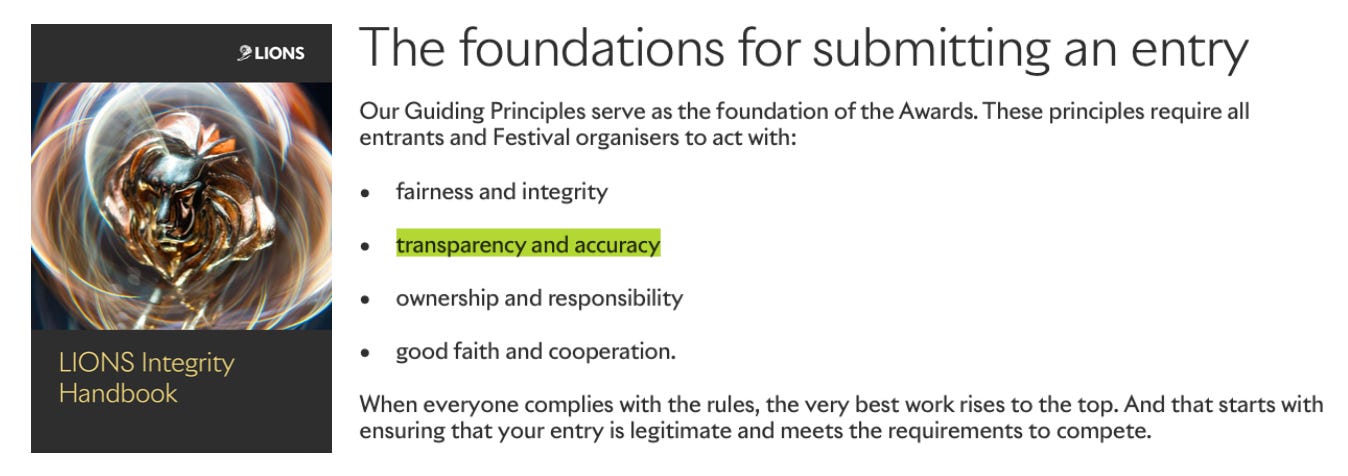
This year, the new commitments to transparency and accuracy were always likely to come under pressure at some point. I share the following story as an account of events so that readers can make up their own minds. I’ve no desire to launch a crusade on this, and you may well decide the case is valid and nothing misleading has occurred.
3. And now the story
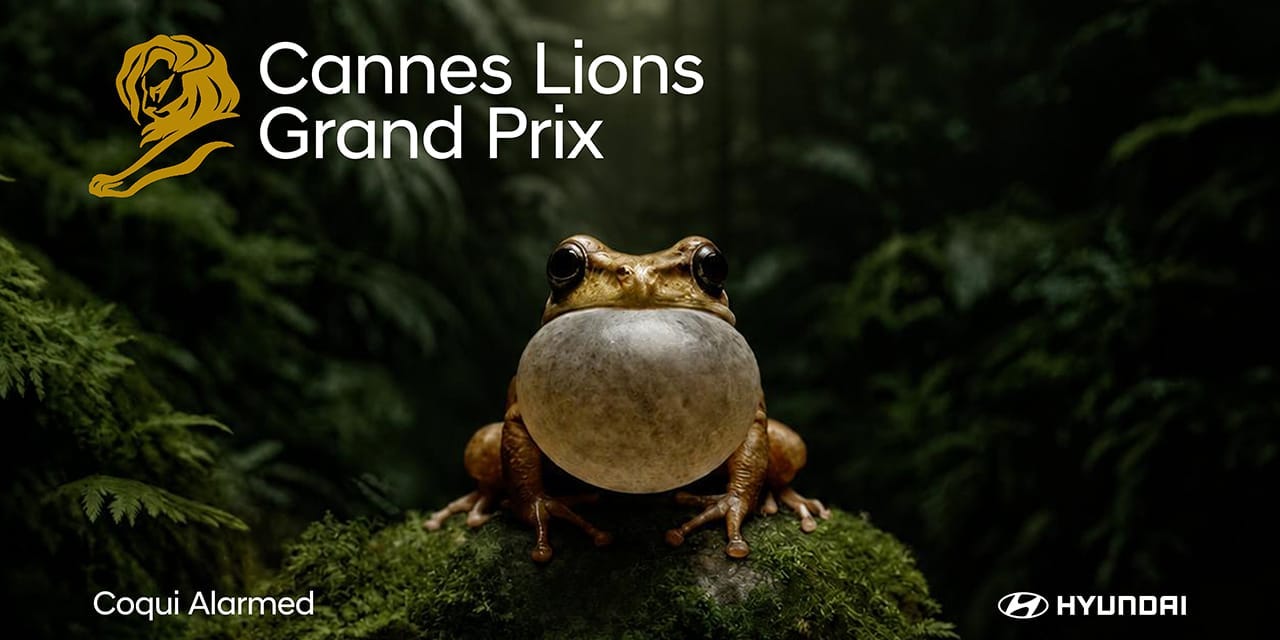
The case is Hyundai Puerto Rico’s Grand Prix-winning campaign ‘Coquí Alarmed’. Created by BBDO Puerto Rico, the campaign was a response to a social media outcry after a tourist posted on Reddit, asking about a spray to silence Puerto Rico’s native frogs, whose loud cry is as distinctive as cricket calls in other parts of the world. The campaign involved Hyundai replacing the standard lock and unlock sound on rental cars with an authentic-sounding coquí call.
So far, this struck me as charming enough – a creative idea that might be an effective awareness-raiser for visiting tourists. However, ‘raising awareness’ is rarely enough to get to you to the top level of Cannes, where even the creativity/craft judges feel the need to award measurable social impact.
Hence the inclusion of the ‘science bit’ in the case study video, in which biologist Samuel Lacén states “The coquí’s song is a mating call. Males sing to attract females. Efforts like this help ensure that coquí frogs can reproduce.”
On first watching the video, this claim immediately struck me as odd. Why would it help them reproduce? If anything, I wondered if a negative effect might be more likely, with frogs becoming confused about nearby mating calls that turned out not to signal the presence of any mate.
As well as odd, it struck me as crucial to the video’s argument. While judges might bring some expertise when it comes to assessing the craft, and maybe weighing the credibility of marketing effectiveness claims, the same judges are unlikely to be experts in coquí mating habits. If a scientist can be brought in to lend their authority, it carries a lot of weight, appearing to elevate the case from a mere awareness-raiser to a credible scientific intervention. In the video shown to the judges, it is the main substantiation for a story that culminates in the claim: “What started as an instant cultural response turned into a conservation effort”.
It took me a minute of curious Googling to discover there is one guy who knows everything about these questions. Professor Rafael Joglar is founder of conservation project Proyecto Coquí, recently retired biology professor at the University of Puerto Rico, and has spent decades researching and conserving the species. I emailed him, and this is where things took a surprising turn.
“I was invited to a meeting with the people that created that campaign,” Professor Joglar told me. “I diplomatically explained [to] them that their campaign had no sense and that it will not help the coquis at all.”
In our email exchange, Professor Joglar said he had explained to the agency that, while the coquí call does attract females, it also serves a territorial function by warning rival males away – a point he says was omitted from the campaign’s explanation. He said he offered alternative ideas for how Hyundai and the agency could help, but met with no interest.
When I asked specifically whether replacing a car locking sound with a recorded coquí call had any plausible conservation benefit, Professor Joglar’s response was unequivocal: “No! No benefits at all.” And when I put the reproduction claim to him – “Efforts like this help ensure that coquí frogs can reproduce” – the response was equally direct: “This is not true and I made this very clear on our meeting.”
4. Follow-up reporting
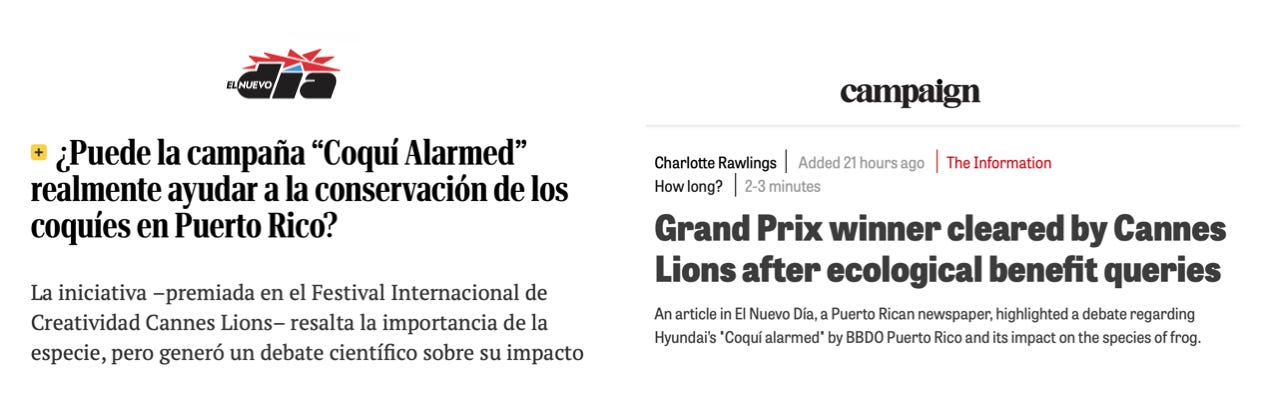
I shared my correspondence with Professor Joglar with Campaign, whose reporter Charlotte Rawlings diligently sought out responses from Cannes and the various parties involved.
In the meantime, the story came to the attention of El Nuevo Día, Puerto Rico’s largest daily newspaper. Reporter Melanie Ortiz Álvarez talked to both Professor Joglar and Samuel Lacen, the biologist featured in the video.
Importantly, when interviewed by El Nuevo Día, Samuel Lacén described the campaign quite differently, no longer repeating the claim that the campaign would help reproduction. A translated extract reads:
Samuel Lacén, the environmental conservation scientist cited in the campaign, said that the sound used by the vehicles would hardly alter the behaviour of the animals.
“Sound is played only once, usually outside of their most active hours, while coquis depend on repetitive songs, with specific frequencies, volumes and temporal patterns to communicate with each other,” he said, considering it unlikely that it will interfere with mating or other natural behaviours.
The article also quotes Professor Joglar, explaining further:
“The singing of the coquí is a highly specialized communication system. The well-known call ‘co-qui’ actually contains two different messages: the ‘co’ works as a territorial warning aimed at other males, while the ‘qui’ is oriented to attract females,” he explained.
According to Joglar, experimental research with recordings of the singing has shown that there is an evolutionary refinement in the way males and females respond to each part of the sound. Therefore, an isolated tone reproduced by a car “does not trigger reproductive responses or favour more mating.” In other words, from the point of view of behavioural biology, the sound used by the campaign does not represent a conservation tool.
When it comes to Samuel Lacén’s contribution, there may be several explanations for the apparent shift – perhaps the video edited his contribution, someone else wrote the narration, or the case study oversimplified his views.
5. Cannes response
All of the above information was put to Cannes by Charlotte Rawlings at Campaign, who received the response:
“Following a thorough review of Coqui Alarmed, including additional supporting information provided by relevant parties, we can confirm that it meets our eligibility criteria and integrity standards. No further action is required.”
Despite the new Cannes commitment to ‘transparency and accuracy’, Cannes has not explained the nature of this ‘additional supporting information’, making it difficult for outsiders to understand how it reached its conclusion.
Nor is it clear how the work meets the ‘integrity standards’ which place a special emphasis on sustainability-related claims, with a requirement to:
“Make sure that any sustainability claims are credible and accurately represent the environmental impact.”
and the specific instruction:
“Don’t exaggerate the impact of your efforts.”
Instead, the response from Cannes is similar to the same brief statements that came out when campaigns faced similar questioning last year.
6. Possible defences
I present all the above so anyone interested can make up their own minds.
One defence might be that the conservation claim wasn’t especially critical to the judging. I find this a weak argument for two reasons. First, the presence of a scientist appearing to endorse the campaign is a key element in a short case study video, giving judges reason to set aside any possible scientific doubts and take the word of an authority figure. Second, the Cannes rules require all claims to be supported – especially sustainability claims – regardless of the extent to which they affect the judges’ decisions, which is hard to discern in retrospect in any case.
Another defence might be that the campaign is still broadly a ‘conservation effort’ and does still broadly ‘help ensure that coquí frogs can reproduce’ – because, if it raises awareness with tourists, that might in turn lead to a more general cultural shift, which would be good for coquí reproduction in the long term. Again, I find this a weak argument as the case study explicitly draws a distinction between this kind of softer cultural response and a more substantive conservation effort. (“What started as an instant cultural response turned into a conservation effort”. ) In the context of Cannes, where countless entries claim to ‘raise awareness’, any claim to go beyond that carries persuasive power.
7. Continuing statistical vagueness
I consider the conservation angle to be the heart of this story. But it’s worth noting that the campaign’s effectiveness claims continue in the same Cannes tradition of big numbers vaguely sourced. Public case materials report:
9m impressions in the first two weeks
(using what methodology? measured by a third party? earned vs paid? duplicate impressions removed? are judges aware that ‘impressions’ usually means an optimistic ‘opportunity to see’ so that one sponsored article on a syndicated platform with a combined audience of 2m can be counted as 2m impressions even if only a tiny fraction have ever seen that particular article?)
+7,000 tourists reached in six weeks
(reached in what sense? drove a Hyundai car? heard the alarm? an estimate or based on actual records?)
3m reach in social media
(using what reporting tools, over what period? Reach for this campaign, for Hyundai in general, for coqui frogs? Organic or paid?)
+98% positive sentiment
(among whom? towards what – Hyundai or coqui frogs? what sentiment analysis tool was used? over what period?)
None of these are key issues in this case, and it may be that some of the answers were provided. But once again, this plays into a familiar pattern of superficially impressive numbers for a campaign that seems to have received minimal coverage beyond advertising awards press.
8. Finally
I’m aware this may come across as unfairly singling out one campaign among many at Cannes. I have nothing against the agency or client and would welcome any information that answers some of the questions above. Once again, some people may read all this and conclude there is nothing misleading about the case and that it should be celebrated.
But there is a wider context. Earlier this year, climate change journalism platform DeSmog wrote about Cannes having a ‘cheating problem’ when it comes to environmental claims in particular – making the argument that this helps sustain a broader narrative about corporations having a win-win relationship with climate issues. In that context, all the above can be seen as one small case in a bigger picture.
For my part, I still think Coquí Alarmed can be defended as a lovely creative idea, worthy of awards for craft and lateral thinking. But the more Cannes judges such campaigns on environmental and social impact rather than creativity alone, the more it enters a world where claims about important issues need to withstand scientific and factual scrutiny. That’s why I share the case here.
Yes, yes and yes! I'm also not particularly invested in a kind of aggy witch-hunt of the agency or Cannes... but:
1 - had I ever seen this ad as a TVC or reel, I know immediately (from your description) it would annoy me for precisely the reasons you outline. My partner and I are often to be found griping at the telly for nonsensical claims in ads etc (we've often thought we should be in ad-based version of Googlebox). It's patronising when the ad agencies/brands think you'll just zone out and accept their claims, or follow a weak bit of narrative for a 'pay-off' that the creatives are too wedded to, to let go. Even when it makes no sense.
2 - your point towards the end about these over-blown or simply inaccurate claims contributing to a wider sense of societal complacency, AND un-earned industry self-congratulation... Worrying for the planet/society/trust... and another frustrating example of the arrogance that's deeply embedded in the industry.
3 - really - what is the point of having a push on transparency and accuracy if you're just going to obfusticate your responses to genuine questions, seeking reasonable answers. I was trying to figure out whether this was 'meta' or 'anti-meta' - but apparently there are a few useful terms for this....'self-exemption' or 'policy-protective bias', 'institutional bad faith' or this was simply just a 'symbolic policy' from Cannes in the first place.
Another breath of fresh air, Nick.