
Creativity needs criticism
Adland's misdiagnosis of its own creative malaise shows exactly why we need more critics writing more 'thought pieces'
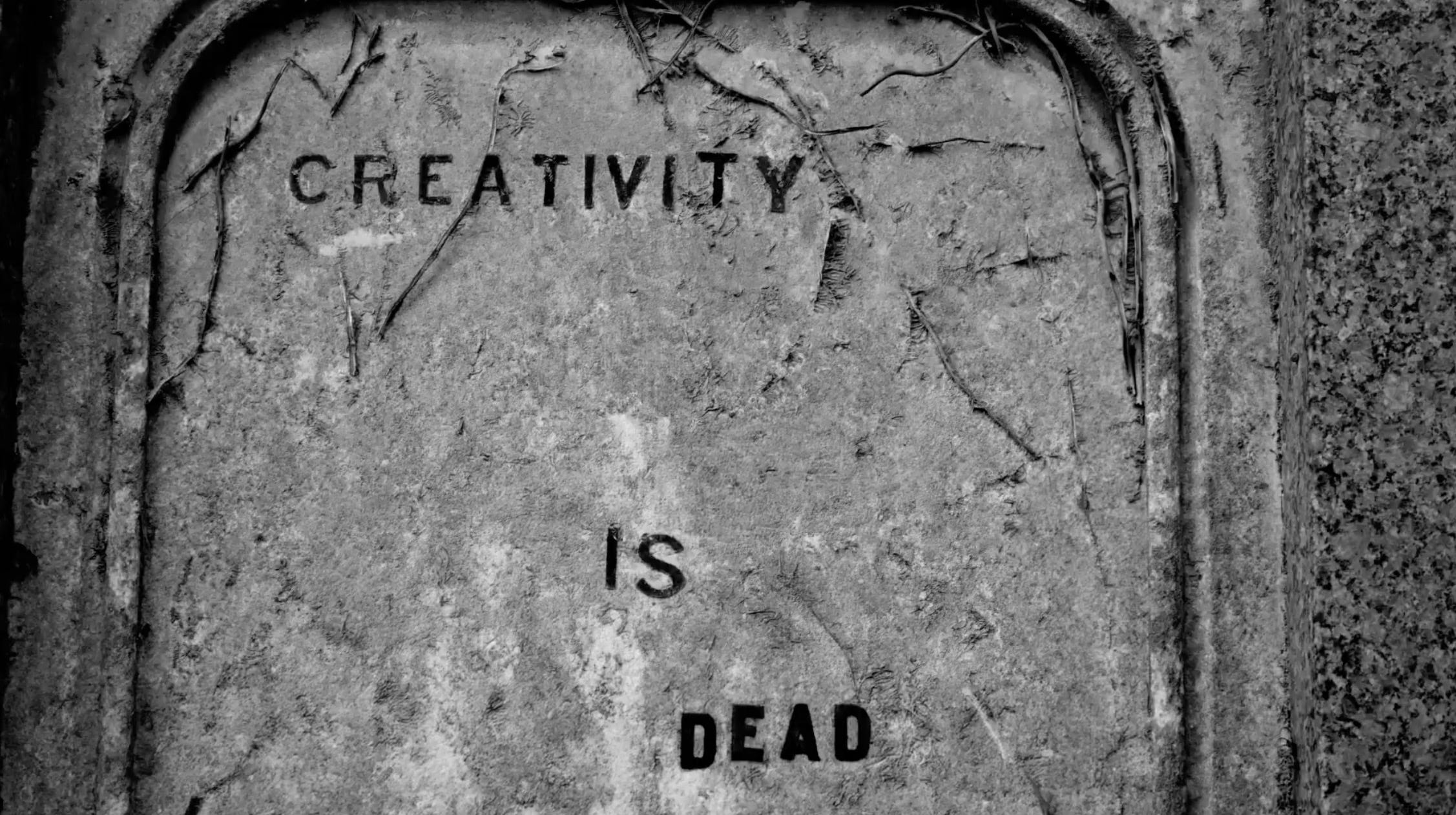
“It is very much more difficult to talk about a thing than to do it,” wrote Oscar Wilde in The Critic as Artist. Adland has a way of proving him right every day.
The latest example comes in the form of a campaign by D&AD, alongside a podcast featuring the creative director behind the campaign—Nils Leonard of Uncommon.
Let’s take each in turn.
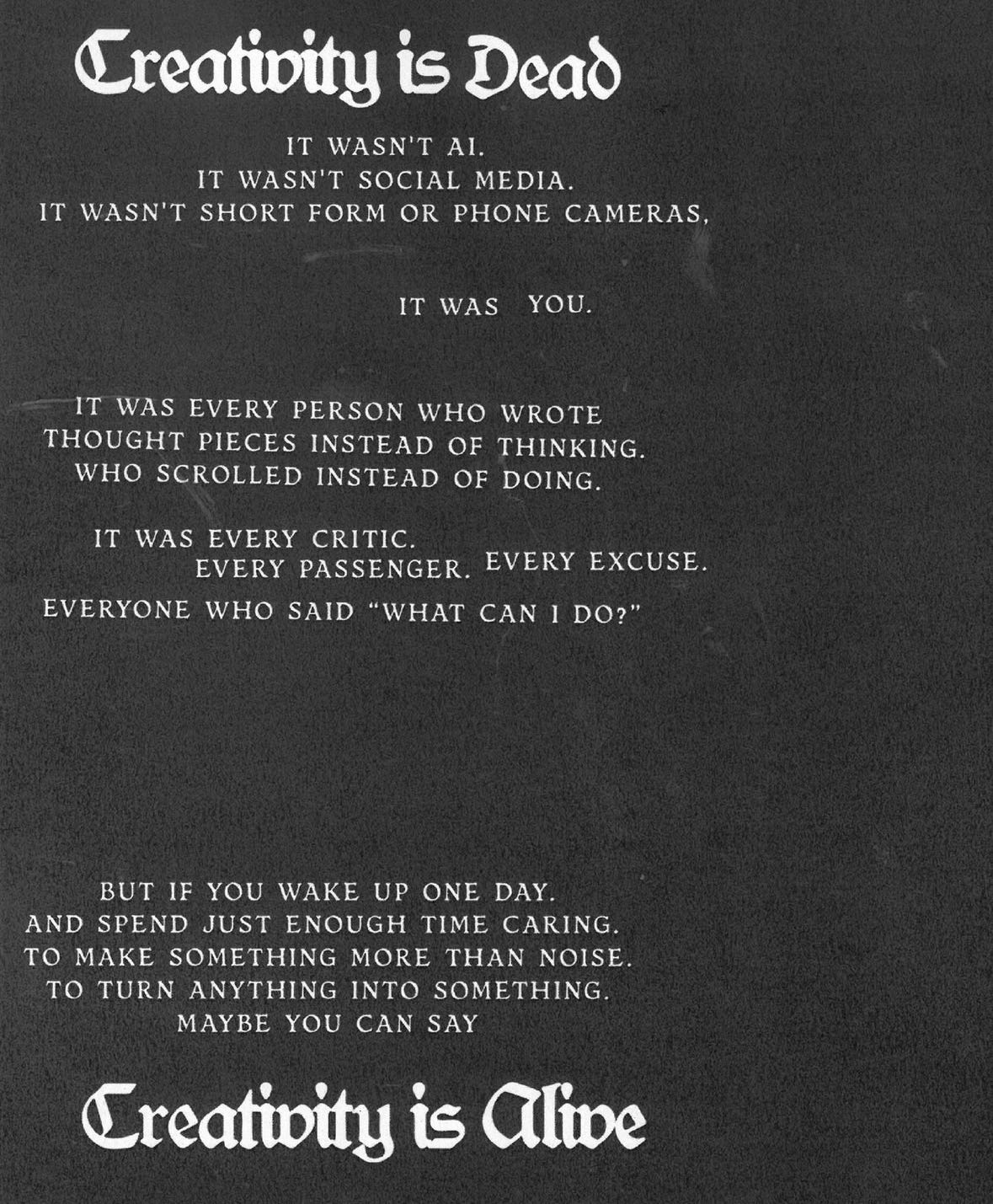
First, the campaign. It’s the latest iteration of an annual campaign by D&AD to promote its awards show and provide an overarching theme for the year.
This year, the theme is the supposed death of creativity. And it’s timely because creativity has indeed been assailed on all sides of late. If we’re looking to identify a culprit at the Cluedo crime scene, we might question Reverend Purpose, Professor Programmatic, Mr Ad Testing, Miss Media Fragmentation, Mr Holding Company, Colonel Cannes, even Doctor D&AD himself. Maybe all of them have been in the billiard room, gleefully beating creativity over the head with a lead pipe.
Instead, the campaign belatedly turns up at the crime scene—and blames the witnesses who reported it. Rather than looking for institutional failures, leadership shortcomings and seismic shifts, it points the finger at you, the individual, writing your little thoughts in your little LinkedIn posts. If creativity is dead, it’s down to your attitude: do better!
On one level, I can sympathise. Faced with the daily barrage of LinkedIn posts and anodyne press commentary, who hasn’t occasionally thought ‘Jesus Christ, shut up and do some good ads’?
But a smarter response might be to point out the deeper dynamics behind arguments like this. A critic in a ‘thought piece’ might relate it to the modern tendency to individualise and psychologise problems that are systemic in nature. Depressed at work? It’s not because of the long hours and low pay—you need to find your inner fire, maybe take these supplements. Struggling to afford rent? Forget low wages and high prices—try a budgeting app and practise your ‘abundance mindset’. Crisis in creativity? Don’t look at us, look in the mirror.
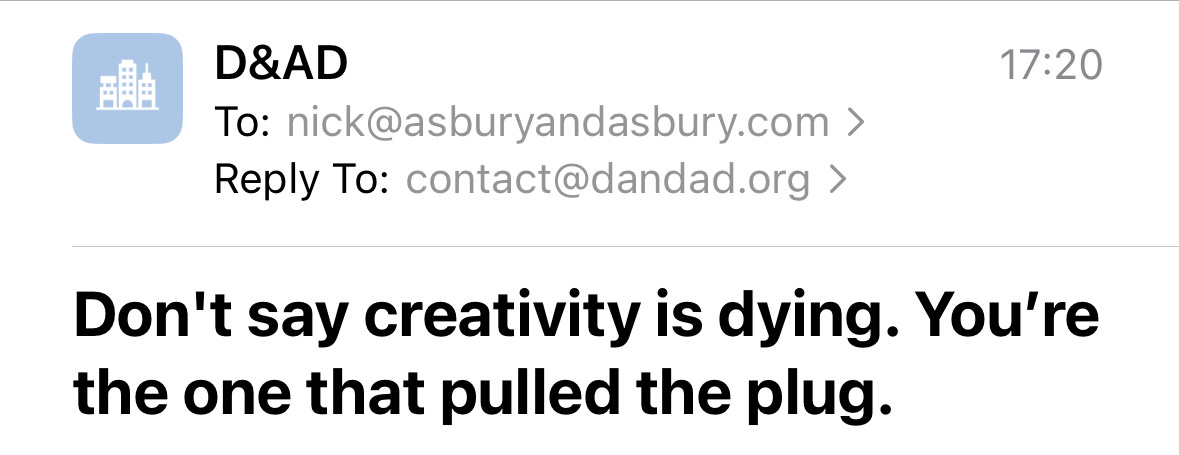
It makes for an interesting email to receive while writing this post. But it also makes for a weak and pretty insulting analysis, especially coming from this organisation at this time.
While its history is dear to any creative’s heart, including my own, D&AD has been culpably wayward in the past decade—not only abandoning its post when creativity faced attack, but rushing to lead the charge.
Particularly in the 2016-2024 years, at a time when we needed an organisation to champion creative excellence in all its forms, we got yet another captured institution pushing a narrow purpose agenda.“Turning social purpose into creative excellence is harder, and should be valued more highly” was the directive of its President in 2021, validating the mindset of so many jurors who award work based on the cause more than the craft (at the expense of agencies like Uncommon as much as anyone else). “Great creative work creates better outcomes for all,” said the CEO of D&AD in 2023—and we all knew “better outcomes” meant promoting the purpose agenda, rather than simply doing brilliant work. “I am very keen to keep pushing this agenda forward,” insisted its Chairman in 2020, and D&AD continues to push it.
The results of this industry-wide shift have been well-documented, leading to the mess we’ve seen at Cannes this year—a sickening parade of purpose projects harnessing social issues to impress naïve creative juries, all based on wild exaggerations and outright falsehoods. The same projects get awarded at D&AD, who are shielded from the worst of the backlash because, to their credit, they are at least a non-profit channelling the entry fees into educational work.
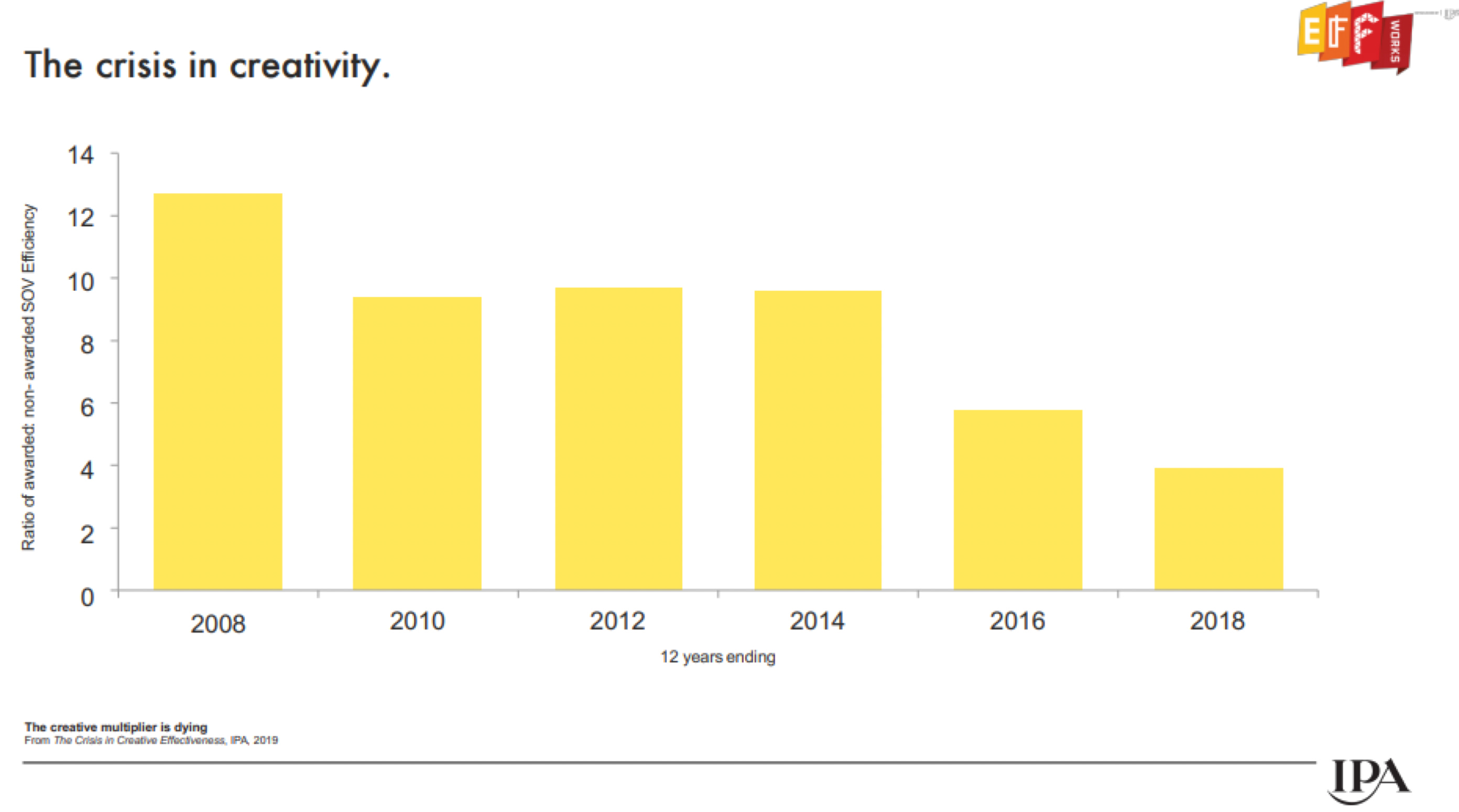
At the same time, we’ve seen a marked divergence between work that gets awarded and work that the public likes, with the chronology tracking the period when creative awards became purpose awards. You might think purpose would take the hit for this. But instead it’s creativity bleeding in the billiard room: ‘Crisis of creative effectiveness’ says the research. ‘Creatively awarded ads, once effective, are now officially average’ say the headlines.
And now we get this campaign, which recognises that creativity is in bad shape—a sobering thought given D&AD’s mission—but projects the blame firmly outwards, away from the institutions and towards the individuals: those troublesome people voicing their opinions and frustrations through the low-rent medium of social media, rather than proper platforms like podcasts.
Which brings us to the podcast in question: an episode of Uncensored CMO, featuring host Jon Evans and guest Nils Leonard, the creative director behind the D&AD campaign.
As you’ll hear in this short clip, Leonard has a particular source of criticism in mind: the Turkey of the Week column in trade magazine Campaign. Readers of the beleaguered industry press will know this is a rare outpost of opinionated critique, usually offering a contrarian view about a campaign being praised elsewhere. Uncommon (Nils Leonard’s agency) has featured several times, so you can understand the frustration on a human level.
I have my own frustrations with Campaign. Even more than D&AD, it has been captured by a narrow, moralising agenda in recent years—perhaps brought on by the small but vociferous backlash that followed when it featured Nigel Farage on its front cover in 2019, daring to ask whether an industry involved in mass persuasion might have anything to learn from the victor of the Brexit referendum. Get back in line you evil bastards, came the reply.
Since then, there have been endless articles about purpose, DEI, sustainability and representation, often sourced uncritically from advocacy groups, alongside ‘school reports’ scoring agencies on their behaviour in these purposeful matters, and all punctuated by brief flashes of heterodoxy from contributors who are seldom heard from again.
Amid that suffocating orthodoxy, the Turkey of the Week column has been an outlier—a reminder of the vigorous critical culture that once accompanied advertising’s most creative times. This is what Nils Leonard’s argument misses. In its most celebrated creative periods, advertising has always embraced a rough-and-tumble critical culture.
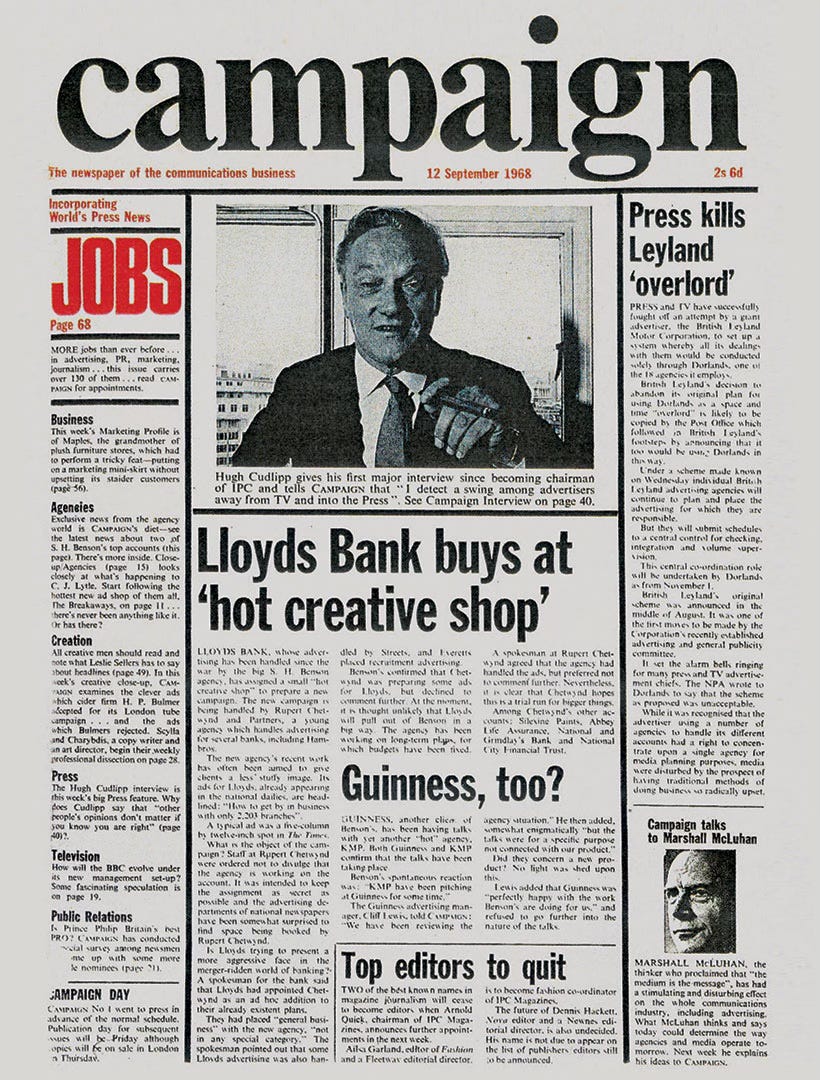
Campaign itself was founded in 1968, directly influenced by the American ‘hustle’ spirit that Leonard celebrates elsewhere in the podcast. Its first front cover featured Marshall McLuhan in the bottom corner—if only intellectuals of that calibre gave a damn about advertising now.
Turkey of the Week has been part of Campaign since at least the early nineties, and somehow advertising managed to thrive throughout that decade. Perhaps the only reason the column is more jarring now is that there’s so little of this critical commentary around. We urgently need more of it, not less.
Oscar Wilde knew the importance of criticism as a creative act—“there has never been a creative age that has not been critical also”. Brian Eno has written about it too. He talks about how great work emerges from ‘scenius’—a concentration of people vigorously arguing about the work and craft, pushing each other to do better, sometimes via highbrow critique, other times via snark and potshots.
We should welcome it all—it’s a sign the industry has some life left in it. And it’s far healthier than a future of podcast bros saying “Love that, dude” to each other for all eternity.
Switching to wide-eyed positivity for a minute, there is much to enjoy in the podcast. Despite the misdiagnosis of the problem, the championing of creativity is exactly right. I want to cheer Nils Leonard to the rafters when he talks about how creative companies—including one of the biggest in WPP—have utterly failed to centre creativity in their offerings.
The idea of rebranding WPP to ‘We Proudly Present’ is more than just a nice backronym: it expresses an offering and attitude that could have been powerful. But somehow ad people lost the confidence to brush aside the McKinseys and Deloittes, sweep into the boardroom and say “We do the weird stuff that you can’t reduce or reproduce, but you know it means everything. It involves a mix of science, art, craft, taste, showmanship, salesmanship, lateral thinking, instinct, humour, playfulness and serendipity. And whatever you’ve heard about AI, it’s about to get more important, not less.”
I truly admire Uncommon for being one of the few companies to centre creativity in recent years, which is partly why D&AD is now looking to them for answers. But if adland wants to fight for creativity again, it can’t start by alienating its one and only ally: the critics and commentators who give enough of a shit to write about it.
Like 95% of advertising, 95% of commentary may be crap. But without the scrolling and the posting, I wouldn’t know about Bob Hoffman’s heroic battles against programmatic and ad fraud, which have seem him frozen out of the same institutions now berating us. I wouldn’t have discovered Steve Harrison’s 2021 column in Campaign that introduced me to his book. I wouldn’t know about Paul Feldwick and his elegant writings on advertising history, which extract so much that is relevant today. And I wouldn’t be able to read journalists like Maisie McCabe daring to make advertising discourse a less dull place—always by criticising the work, not the people.
And here’s the important, Oscar Wildean bit:
Critics and creatives are fighting the same battle because they’re the same people: literally, in the case of a Steve Harrison or Bob Hoffman; and figuratively, in the sense that critics are using writing as a way to embody thoughts where previously there was just a vague feeling and a blank page. Many of the critics are driven by that same desire to ‘do something’—in their case, to puncture the institutional narratives that hold back true creativity and penalise the Uncommons of this world, alongside many smaller agencies where the best creativity often resides.
Over the past decade, creatives have been forced to live through a period of timid orthodoxy in advertising, from which we might yet have a chance to emerge. Yes, we need more people logging off and creating, but we also need more people thinking critically and writing about it. Launch your Substacks, publish your drafts, write your thought pieces, post your comments.
Just don’t say anything shitty about me—there are limits.
Thanks for reading. For anyone new here, I am this guy, this is my book and this is the new German edition.
Oh I LOVED reading this! Thank you! I have just started a substack to simply learn how to write better after coming back from a second maternity leave. I see writing as building up muscle - the only way I’m going to get better is by doing.
So thank you for the validation and push. Selfishly I love the timing of this post (and also love your writing too).
I also want us as an industry to get back to some excitement about creating better - to stop feeling that we’re fire fighters and start thinking like creative futurists ✨
Also, I enjoyed your book Nick and reading this reminds me to take it down off my shelf and read it again! Thanks